Written By: Rtr. Sanithi Jayasinghe
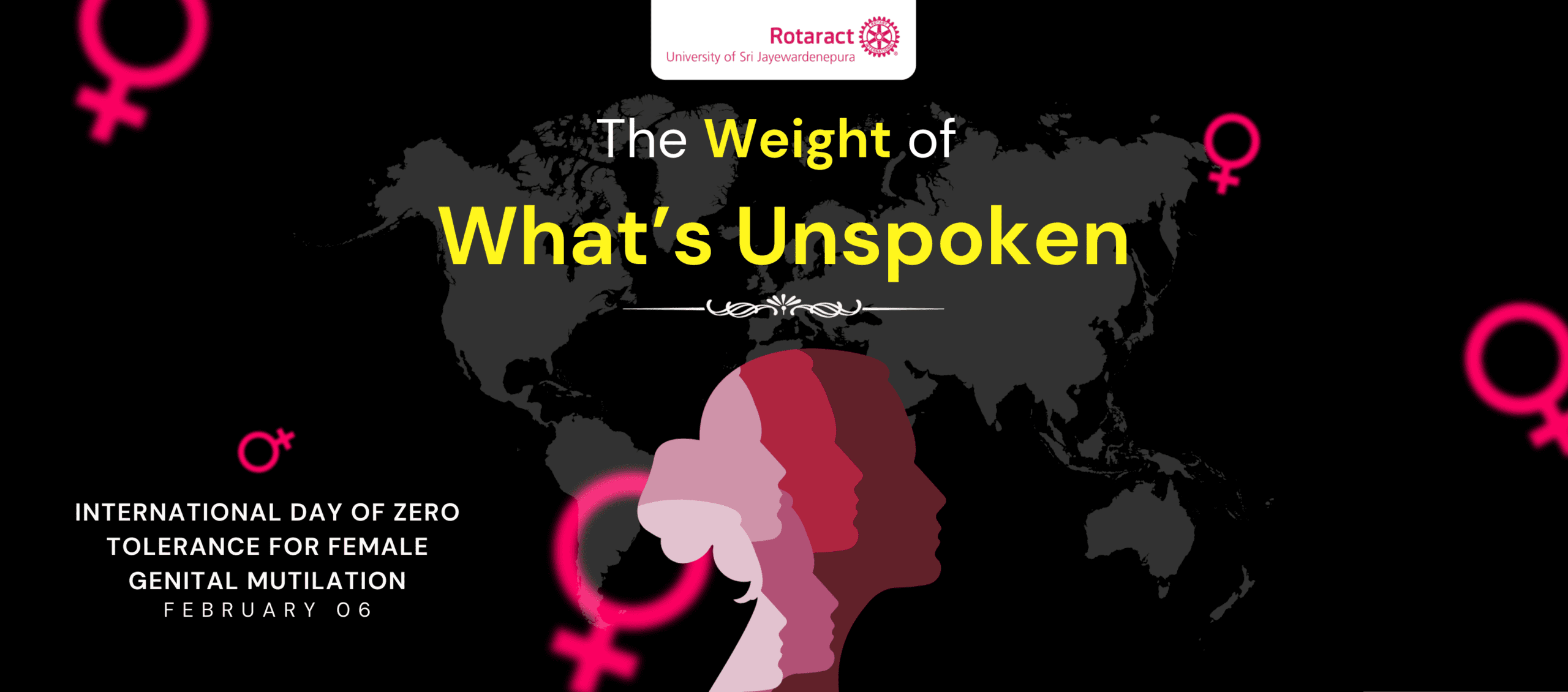
Every year on February 6, the world observes the International Day of Zero Tolerance for Female Genital Mutilation (FGM), a day dedicated to ending a harmful practice that violates the rights, health, and dignity of girls and women. While often stories are hidden behind silence, Female Genital Mutilation continues to affect millions globally, and evidence shows it is not absent from Sri Lanka as well.
Female Genital Mutilation comprises all procedures involving partial or total removal of the external female genitalia or other injury to female genital organs for non-medical reasons, as defined by the World Health Organization (WHO). The practice has no health benefits and causes lifelong physical, psychological, and emotional harm.
According to UNICEF and WHO, over 230 million women and girls worldwide are living with the consequences of FGM today. Each year, an estimated 4 million girls remain at risk, and without accelerated action, millions more could be subjected to this practice by 2030 , the target year for eliminating FGM under Sustainable Development Goal 5.3.
Waris Dirie, author of Desert Flower and a global advocate against FGM, captures the pain behind these statistics:
“When I was a child, I did not want to be a woman, because it was so painful. Let us come together and change what it means to be a woman.”
FGM in Sri Lanka: Breaking the Silence with Data
Although often denied or underreported, independent research and field reports indicate that FGM is practiced within some Muslim communities in Sri Lanka, including Moor, Malay, and Dawoodi Bohra communities.
As highlighted in recent surveys:
- · 76.9% of surveyed women confirmed they had undergone FGM
- 15.4% assumed they had undergone it
- · 3.8% were unsure
- · Only 3.8% confirmed they had not undergone FGM
It is estimated that approximately 9.8% of Sri Lanka’s population may be affected, though the lack of official reporting means the true scale remains uncertain.
The age of cutting varies:
- Among Moor and Malay communities, it often occurs on the 15th or 40th day after birth
- Among Dawoodi Bohra girls, usually around the ages of six or seven
- In some cases, adult women are subjected to FGM later in life.
These findings remind us that FGM is not a distant issue; it exists within our own society, often normalized and carried out in secrecy.
Voices Behind the Numbers
Statistics alone cannot capture the trauma endured by survivors. One such voice is Fatima, who recalls:
“My mother took me to the nearby village where I found other young girls brought to be cut… I thought I’d die due to the pain.”
Her words echo the experiences of countless girls whose suffering is silenced by tradition and fear.
As Rotaractors, we are leaders committed to service, ethics, and social justice. Ending FGM aligns directly with our responsibility to protect human rights, promote gender equality, and empower communities through awareness and education.
FGM is driven by inequality, misinformation, and deeply rooted social norms, all of which can be challenged through informed dialogue and collective action.
We must also be reminded that every number is a voice. Every silence broken is a step forward.
On this International Day for the Prevention of Female Genital Mutilation, let us:
- Speak openly and responsibly
- Educate ourselves and others
- Support survivor-centered advocacy
- Challenge harmful practices with empathy and courage
Together, let us redefine womanhood not as pain, but as dignity, choice, and strength to build a resilient community where womanhood isn’t a misfortune but a future without scars and a celebration untouched by the malpractices of society in the disguise of tradition.
Graphic Design by: Rtr. Buthma Menali


0 Comments