
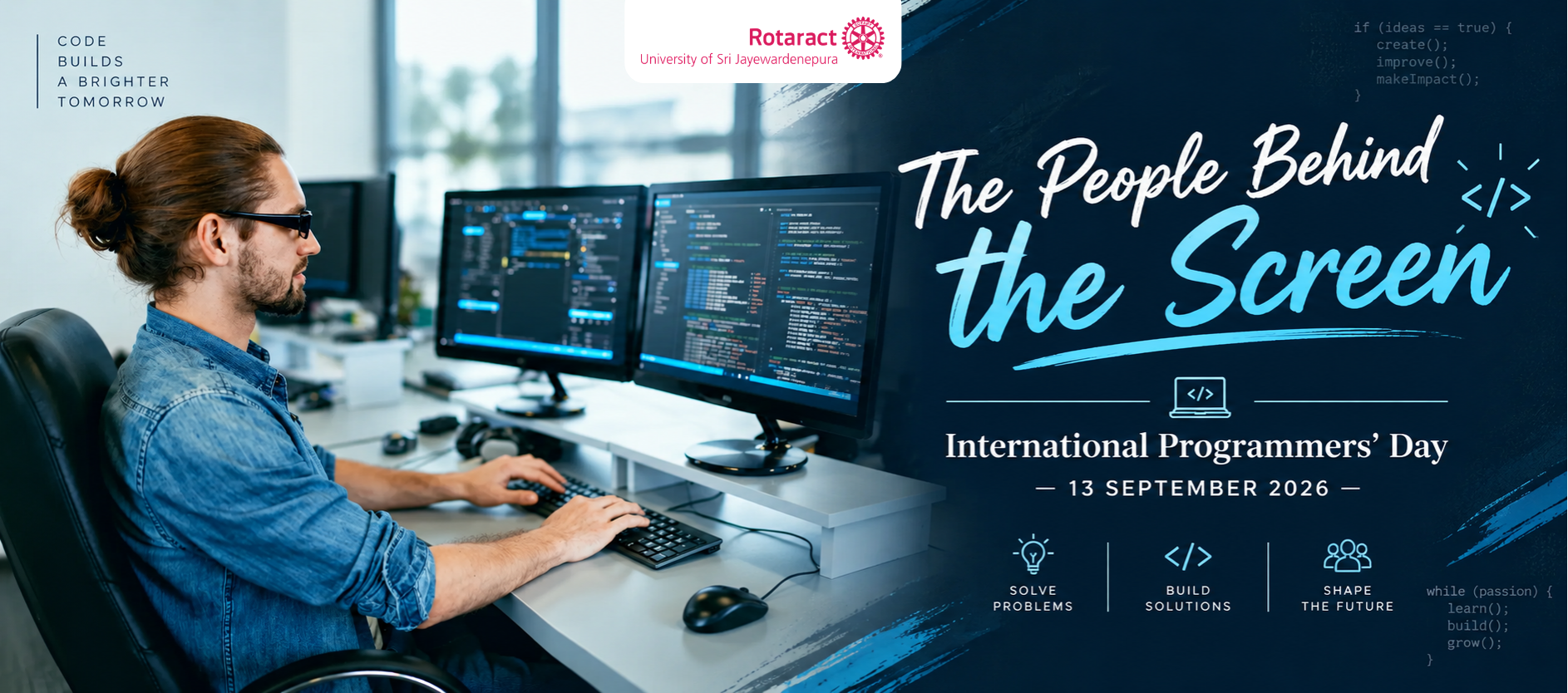
International Programmers’ Day – 13 September 2026
Written by: Rtr. Devni Thamodya

Think about the first thing you do when you wake up. Perhaps you reach for your phone, check a message, scroll through social media, look at the weather, or listen to a song. Before the day has even properly begun, you have already interacted with the work of a programmer.
Yet, we rarely stop to think about the people behind the screen.
The applications we open, the websites we visit, the maps that guide us, the systems that process our payments, the games that entertain us, and even the artificial intelligence we now ask questions to all depend, in one way or another, on something created through code. Programming has quietly become part of the language through which our modern world communicates.
And perhaps that is what makes International Programmers’ Day worth celebrating.
Programming is often imagined as someone sitting alone in front of a computer, surrounded by lines of complicated code. But behind those lines are ideas. There is curiosity, creativity, problem solving, patience, and sometimes an unreasonable amount of time spent wondering why a program refuses to work because of one missing character.
At its heart, programming is not really about computers. It is about teaching an idea to come alive.
Every button we press has a story behind it. Every notification, search result, recommendation, animation, and digital service has a process working quietly in the background. Programmers take problems that may seem complicated and break them into instructions that machines can understand.
That ability has become increasingly important as the world around us becomes more digital.
From healthcare and education to banking, transportation, entertainment, and communication, technology now influences almost every part of modern life. Software is no longer simply something that exists inside a computer. It is woven into the systems that allow societies, businesses, and communities to function.
And behind all of this are people who spend countless hours making these systems work.
As a programmer myself, I know that programming is not always the calm, aesthetic picture we see on social media: a laptop, a cup of coffee, colourful code on the screen, and everything somehow working perfectly.
Sometimes, it is hours of staring at the same piece of code, wondering why something that worked perfectly five minutes ago has suddenly decided not to cooperate. Sometimes, one small change fixes one problem and somehow creates three more.
And then comes the sentence almost every programmer has said at some point:
“But it was working five minutes ago.”
There is a strange kind of satisfaction in finally finding that tiny missing bracket, semicolon, or misplaced character after spending hours looking for it. To someone else, it might be nothing. To a programmer, it can feel like winning a battle.
Programming can be fun, but it can also be hectic.
There are days when programmers become almost like working machines, sitting in front of a laptop or desktop for hours, completely absorbed in solving a problem. You sit down thinking, “I’ll just work on this for an hour.”
Then you look outside the window.
Wait… when did it become dark?
And sometimes, the more dangerous question is:
“When did it become morning?”

Programming has a funny way of making time disappear. Day becomes night, night becomes morning, and somewhere between the first error and the final successful run, the clock becomes almost irrelevant.
Yet, behind those long hours is often something simple: the excitement of creating something meaningful.
A small idea that existed only in someone’s head can become a website, an application, a system, a game, or a tool that makes someone’s life a little easier. That feeling of seeing something you imagined actually work is one of the reasons programmers keep returning to their screens, even after promising themselves they are absolutely, definitely, not going to spend another five hours fixing one bug.
We know we probably will.
And the world of programming is changing just as quickly as the technology around it.
Artificial intelligence has introduced a new chapter into the story of software development. Tools powered by AI can now generate code, explain programming concepts, identify errors, and assist developers with everyday tasks. According to Stack Overflow’s 2025 Developer Survey, 84% of respondents said they were using or planning to use AI tools in their development process.
But perhaps the rise of AI makes the role of programmers even more interesting rather than less important.
Because writing code is only one part of programming.
A machine can generate a piece of code, but someone still needs to understand the problem, decide what should be built, question whether the solution is correct, consider its consequences, and make sure that technology is being used responsibly.
The future may therefore not belong simply to those who can write the most code, but to those who can think critically about what should be created in the first place.
There is also something fascinating about the number behind this celebration.
Programmers’ Day falls on the 256th day of the year: September 13 in a normal year and September 12 in a leap year. The number 256 is not random. It is 2⁸, representing the number of possible values in an eight bit byte, a fundamental concept in computing. Russia officially recognised Programmer’s Day as a professional holiday in 2009.
It is almost as though the celebration itself speaks the language of programmers.
256 may be just a number to most of us. To a programmer, it carries a little piece of history.
But programmers do not work in isolation from the rest of society.
Behind every successful digital product are designers who think about how people interact with it, communication teams that explain it, researchers who understand what people need, project managers who bring ideas and people together, and communities that test, question, and improve what is created.

This is where communication and media become especially important.
Technology can be incredibly powerful, but technology that people do not understand can easily become technology that people fear or misuse. Clear communication helps turn complicated ideas into something accessible. Media can introduce emerging technologies to the public, challenge misinformation, highlight important innovations, and give people a better understanding of how digital systems affect their lives.
In a world increasingly shaped by technology, digital awareness is no longer something reserved for programmers. It belongs to everyone.
A young student learning their first programming language may not realise where that first line of code could lead. It could become an application that helps someone learn. A system that makes a process easier. A website that connects people. A tool that solves a problem nobody had solved before.
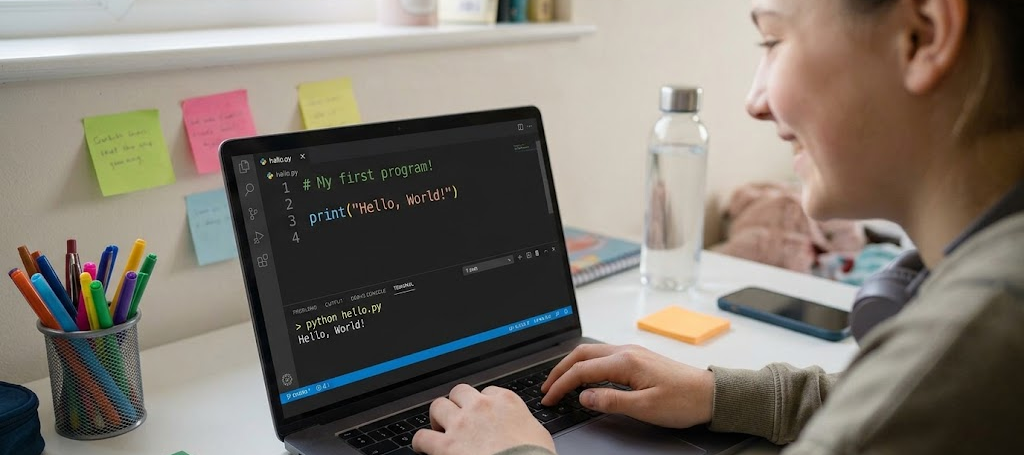
Or perhaps it simply becomes a first lesson in learning how to think differently.
Because programming teaches something far beyond syntax.
It teaches us that a large problem can be divided into smaller ones. That mistakes can be found and corrected. That failure does not necessarily mean the end of an idea. Sometimes, it simply means that something needs to be approached from another angle.
Maybe that is the real spirit of International Programmers’ Day.
Not simply to celebrate people who write code, but to celebrate the minds that turn problems into possibilities.
The programmers of today are building more than applications and websites. They are contributing to the systems that will shape how we learn, communicate, work, and live tomorrow. And as technology becomes more deeply woven into our everyday lives, their responsibility grows alongside their influence.
So, on this Programmers’ Day, perhaps we can look at the screens around us a little differently.
The next time an application loads almost instantly, a map finds the way home, a message reaches someone on the other side of the world, or an AI responds to a question, remember that somewhere behind that experience is an idea that someone once had to turn into reality.
Perhaps we do not need to understand every line of code to appreciate what programming makes possible.
We simply need to remember that behind every piece of technology is a person who imagined that something could work, and then chose to build it.
And maybe that person is currently sitting in front of a laptop, wondering why the code that worked five minutes ago has suddenly stopped working.
They’ll probably figure it out. Eventually.
After all, the digital world we live in today was not simply programmed into existence. It was imagined, questioned, created, tested, broken, rebuilt, and improved, one line at a time.
Graphic Designed by: Rtr. Nethmi Tharushika


0 Comments