
United Nations Day – 24 October 2026
Written by: Rtr. A.M. Amandi Dissanayake
Imagine a world where every country, regardless of its size, wealth, or power, has a place at the same table. A place where disagreements can be discussed, where common problems can be faced together, and where the hope of a better future can be shared. In a world divided by borders, languages, cultures, and countless differences, perhaps one of humanity’s greatest achievements is the decision to come together.
United Nations Day, observed every year on 24 October, is more than a date on the international calendar. It marks the anniversary of the entry into force of the United Nations Charter in 1945, the document that formally brought the United Nations into existence. The UN was created in the aftermath of the Second World War, when nations sought to build a system of international cooperation capable of preventing future generations from experiencing the same devastation. Today, the Organisation has grown from its original membership to 193 Member States, providing a global forum where countries can discuss shared challenges and pursue collective solutions.
United Nations Day was officially established in 1947, when the General Assembly designated 24 October as the anniversary of the Charter’s entry into force. Since 1948, the day has been observed around the world as an opportunity to reflect on the goals and achievements of the Organisation and to renew support for international cooperation.
But what exactly does the United Nations stand for?
At the heart of the UN Charter are ideas that remain deeply relevant today: maintaining international peace and security, encouraging friendly relations among nations, promoting international cooperation, and advancing human rights and fundamental freedoms. Over the decades, the work of the United Nations has expanded into areas that affect everyday life, from education and health to humanitarian assistance, climate action, sustainable development, and the protection of vulnerable communities.
And perhaps that is why United Nations Day still matters.
The world we live in today may look very different from the world of 1945, but many of its challenges cannot be solved by one country alone. Climate change does not stop at borders. Economic inequalities can affect entire regions. Humanitarian crises can cross national boundaries. Rapid developments in technology and artificial intelligence are creating opportunities while also raising new questions about safety, rights, and responsibility.
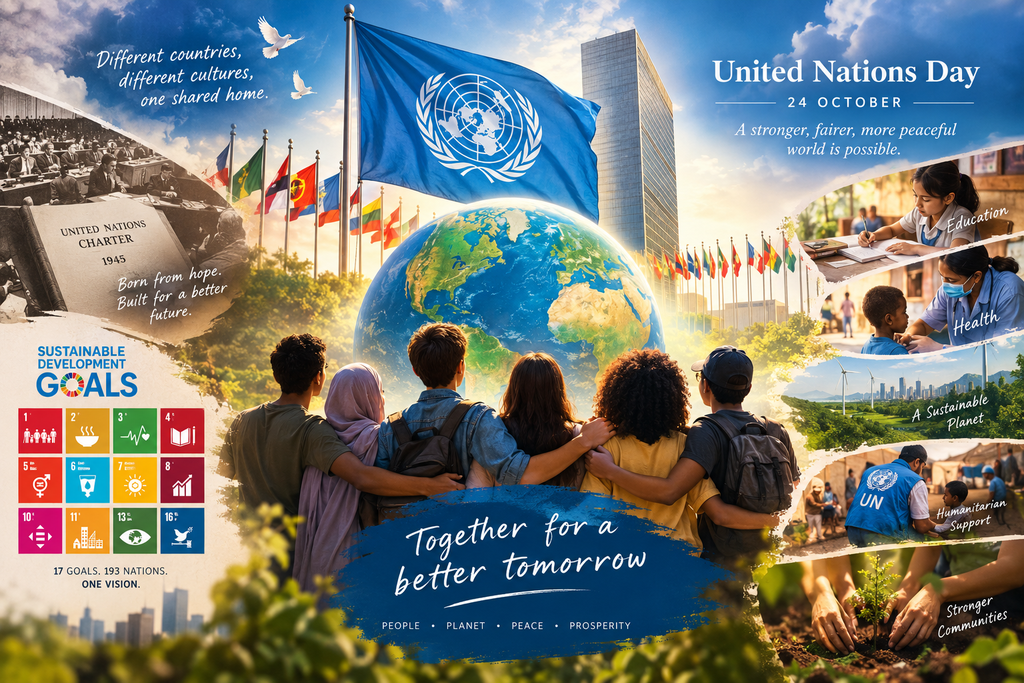
The progress of the Sustainable Development Goals (SDGs) shows both what international cooperation can achieve and how much remains to be done. The UN’s 2025 progress report found that millions of lives have improved over the past decade through advances in areas such as health, education, electricity, and digital connectivity. Yet, among the SDG targets with sufficient trend data, only 35% were on track or showing moderate progress, while 18% had regressed. The report identifies conflict, climate change, inequality, and financing challenges as major barriers to progress.
At the same time, efforts to strengthen global cooperation continue. In 2024, UN Member States adopted the Pact for the Future, together with the Global Digital Compact and the Declaration on Future Generations, with the aim of making international cooperation more effective and better prepared for the challenges of the twenty-first century.
Yet United Nations Day should not leave us thinking that global change belongs only to governments and international institutions.
It belongs to us too.
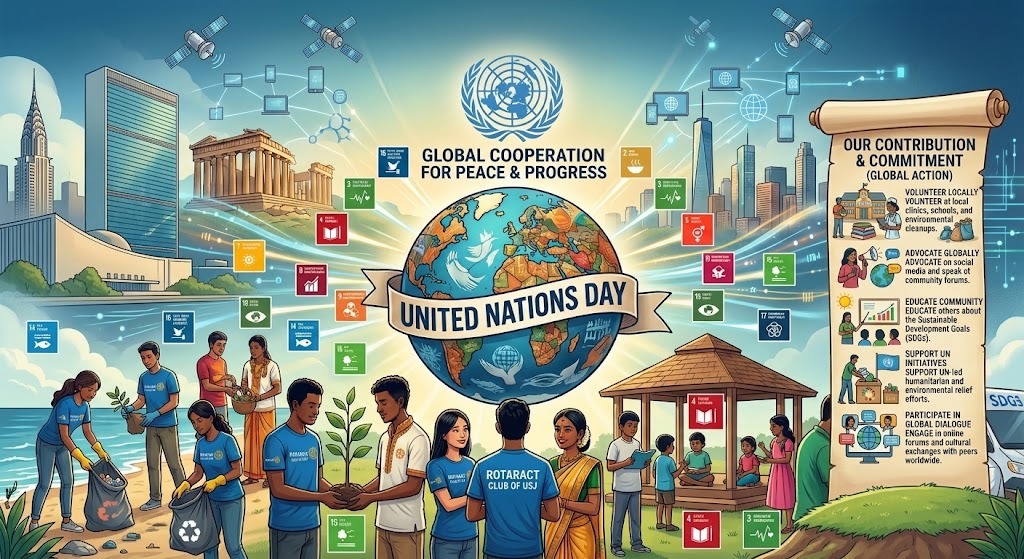
Individuals can contribute by learning about global issues, respecting human rights, challenging misinformation, protecting the environment, volunteering in their communities, and supporting initiatives that promote inclusion and dignity. Schools, universities, clubs, and community organisations can create discussions, awareness campaigns, educational programmes, and service projects that connect local action with global challenges.
For young people especially, this responsibility carries a unique meaning. The United Nations itself recognises that the ideas, energy, and participation of young people are essential to building peaceful, inclusive, and sustainable societies.
For organisations such as Rotaract, United Nations Day can therefore be more than an awareness observance. It can be a reminder that service does not have to begin on a global stage. A community clean-up, an educational programme, a donation drive, a mental well-being initiative, a campaign for equality, or simply creating a space where different voices are heard can all become part of something larger.
Because the United Nations was built on a simple yet powerful idea: that humanity achieves more when it chooses cooperation over isolation.
On 24 October, we celebrate an organisation. But beyond that, we celebrate an idea: that despite our differences, we share one planet, one future, and many challenges that no nation can face alone.
Perhaps the real spirit of United Nations Day lies not in asking what the world can do for us, but in asking what we can do for the world around us.
The future of international cooperation may be shaped in conference halls and assemblies, but its foundation is built much closer to home, in our choices, our communities, and the way we choose to treat one another.
After all, a united world does not begin when every nation agrees.
It begins when people choose to stand together.
Graphic Designed by: Rtr. Nethmi Tharushika


0 Comments