
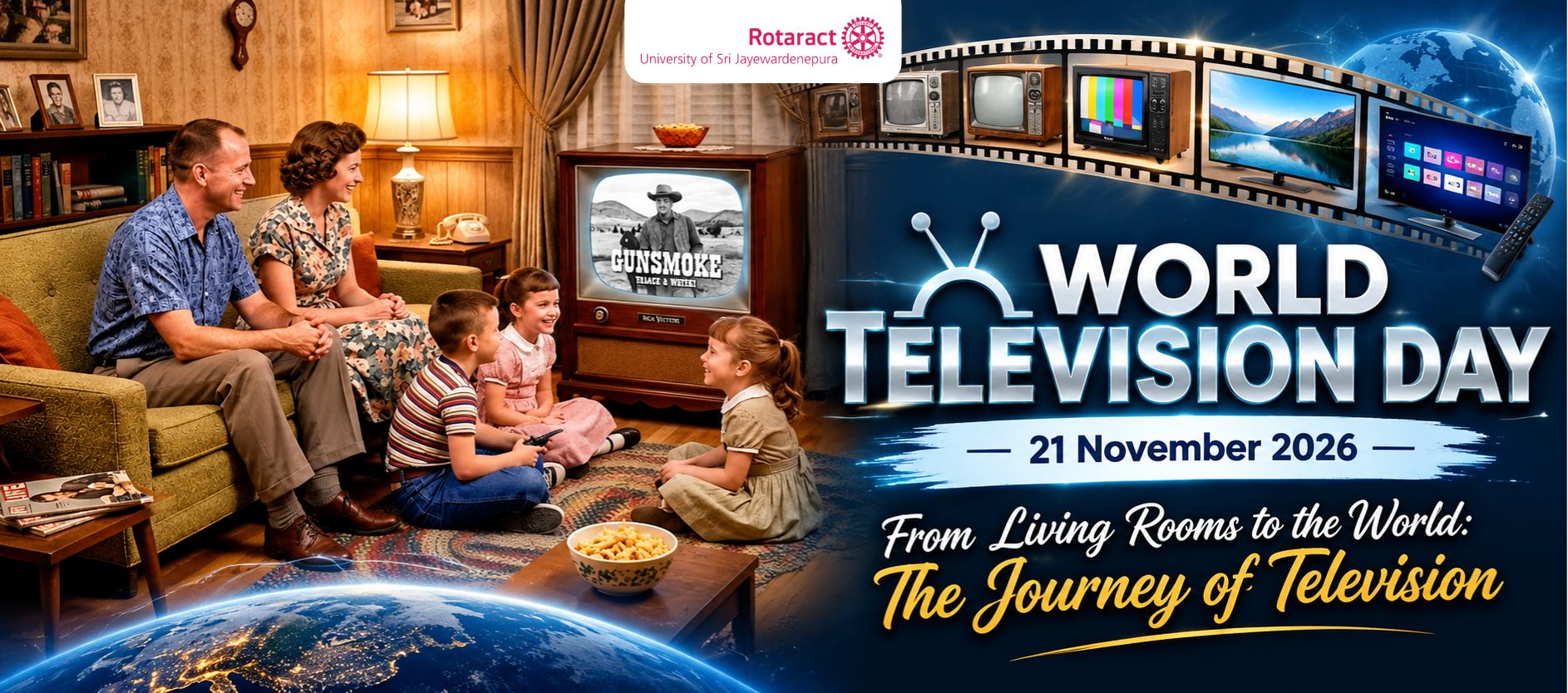
World Television Day – 21 November 2026
Written by: Rtr. Pamodi Gunasekara
Think of a family gathered in front of a television on an ordinary evening. A child watches a colourful cartoon, parents follow the evening news and grandparents enjoy a familiar teledrama. Different generations, different interests, yet one screen brings them together. For many of us, television has always been more than a device in the living room. It has been a window to the world, a source of information, a storyteller and a companion through countless moments of everyday life.
Celebrated annually on 21 November, World Television Day recognises the influence of television as a powerful medium of communication and its contribution to global awareness, cultural exchange and social development. The United Nations General Assembly proclaimed this day in 1996, following the first World Television Forum, held on 21 and 22 November of that year. The initiative acknowledged television’s growing influence on public opinion and its potential to promote dialogue, cooperation and understanding among nations.
Television has witnessed some of humanity’s most unforgettable moments. From historic achievements and political developments to sporting victories and scientific discoveries, it has allowed people to experience events beyond their immediate surroundings. It has transformed distant happenings into shared human experiences, making the world feel a little closer than it really is.
Its influence, however, reaches much further than broadcasting memorable events. Television has become an important part of how societies receive information, develop opinions and understand the world around them. News programmes bring attention to issues that might otherwise remain unnoticed. Educational content introduces new knowledge to audiences of different ages, while documentaries offer perspectives on cultures, environments and challenges that many people may never encounter personally.
Yet, the influence of television comes with an important responsibility. A broadcast can inform millions, but it can also shape perceptions, influence decisions and reinforce particular viewpoints. Sensational reporting, misinformation and a lack of balanced representation can affect how audiences understand important issues. In a world where information travels rapidly, responsible journalism, ethical broadcasting and media literacy are more important than ever.
Meanwhile, television itself is experiencing a remarkable transformation. Streaming services, smart televisions and digital platforms have changed the relationship between broadcasters and audiences. Viewers now have greater freedom to choose what they watch, when they watch it and how they access it. Traditional television is no longer the only gateway to visual entertainment. Nevertheless, its ability to bring large audiences together for shared experiences remains significant.
As we mark World Television Day, it is worth recognising that television is not simply a technological invention or an entertainment medium. It is also a powerful communication platform with the ability to inform, educate, connect and influence society. Its value depends not only on the stories it broadcasts but also on the responsibility with which those stories are told.
Graphic Designed by: Rtr. Nethmi Tharushika


0 Comments